
Buyers now ask AI tools about their automation problems. Those tools quote whoever answers the question best, not whoever builds the robot that could actually solve it. Most robotics websites are still describing the robot.
Answer engine optimization (AEO) is the practice of making your content easy for AI tools like ChatGPT, Perplexity, and Google's AI Overviews to find, understand, and quote. Where SEO competes for a ranked link, AEO competes to be the source an AI answer is built from, and to be described accurately when a buyer asks about you.
AEO decides whose words an AI answer is built from
A search engine returns a list of links and leaves the buyer to click through and read the results. An answer engine reads the results itself and writes the buyer an answer. Google's guidance for site owners says AI Overviews and AI Mode may break one question into several related searches. The answer is then assembled from what those searches return, with links to the pages it used.
ChatGPT search and Perplexity work in a broadly similar way: they search the web, write an answer, and cite their sources. What wins in that process is a passage that answers a question cleanly, not a page that ranks well overall.
Most of what makes a page rank still matters, because answer engines pull from the same pages search engines do. The difference is what happens next. A ranked link gets you a click and a chance to make your case on your own page. A passage quoted in an AI answer makes the case before the buyer ever reaches your site, and it can just as easily come from a competitor as from you. AEO is the way to make sure it comes from you.
The bigger shift is how buyers check you, not how they find you
In February 2024, Gartner predicted that traditional search engine volume would fall 25% by 2026 as people shifted to AI chatbots. That didn't happen. On Alphabet's first-quarter 2026 earnings call, Sundar Pichai said Google's "queries are at an all-time high" and credited AI Overviews and AI Mode for the growth.
Instead of losing people to AI chatbots, as Gartner expected, Google started answering their questions itself. That means a buyer's first impression of your category increasingly forms on Google's page, not yours.
A more useful question is how buyers actually use AI tools, and 6sense's 2026 Global B2B Buyer Experience Report, released November 2, has the latest answer. In a survey of 4,611 recent B2B buyers, 81% used an AI model like ChatGPT somewhere in their evaluation, but only 26% used one to discover vendors. Most used it to sort, summarize, and check what they already knew. The same study found that buying groups chose the vendor they already favored before talking to any seller 82% of the time, and that sellers typically joined about 59% of the way through a 10.3-month buying cycle.
So AEO is less about getting found. It's about how you're described when the buyer checks you out, during the long stretch before anyone from your team is in the room.
Robotics buyers ask in plant language, and most robotics sites answer in lab language
Robotics companies are usually founded and run by people who know the product better than anyone. That's an advantage in a demo and a liability on a website, because the site ends up written for an evaluator who already understands the technology. The person asking an AI tool about automation usually isn't that evaluator. It's an operations or finance leader describing a problem in their own terms, and the engine quotes whichever page answers in those terms. Robotics websites tend to miss that in four ways that are specific to how robotics gets sold.
What does the buyer actually type?
Buyers ask about their own operation: the problem, the cost, the risk. Vendor pages describe the product: the architecture, the capabilities, what the AI was trained on. Here's what that looks like in practice, with illustrative examples.
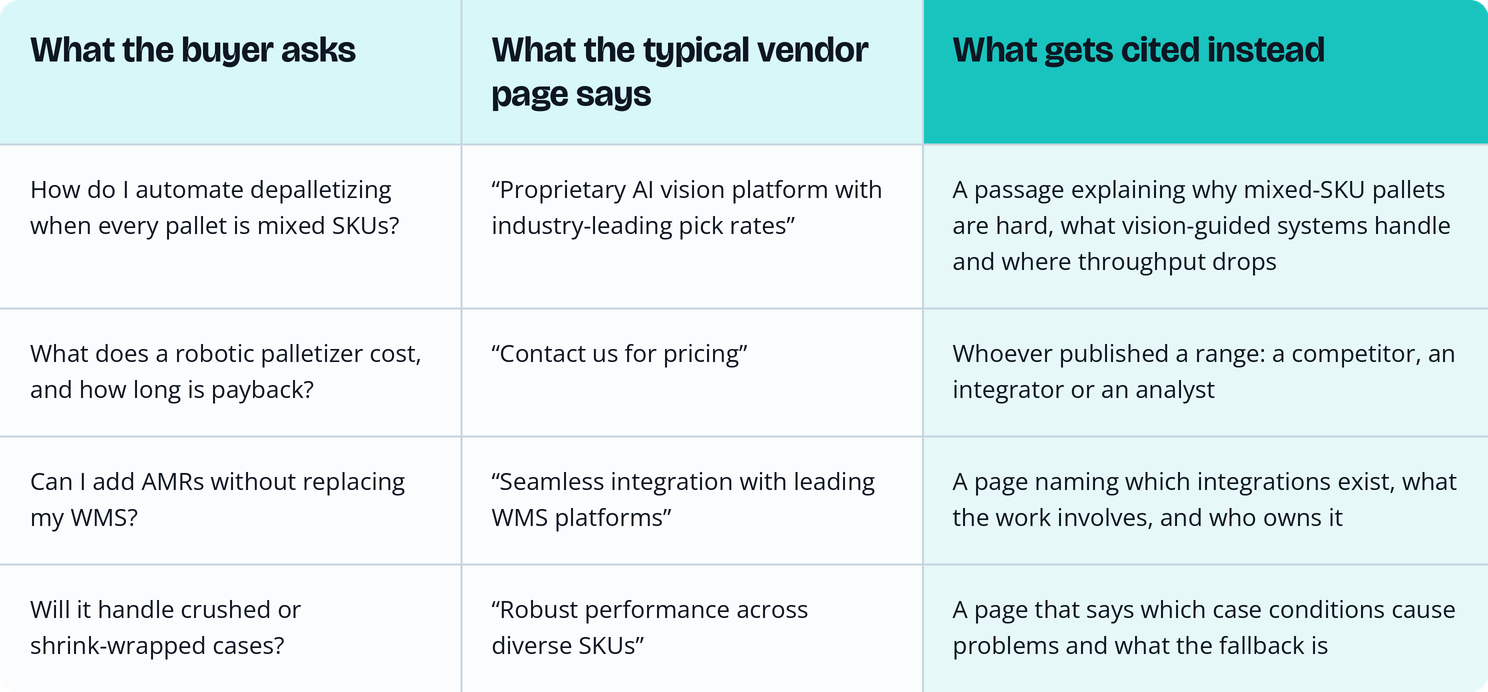
The vendor copy in the middle column is accurate; it just answers a question the buyer didn't ask. The engine breaks the buyer's question into parts and looks for the passage that best answers each one. A passage that names the problem, explains it, and gives the tradeoff wins, and its author gets named. A vendor page can be about exactly the right topic and still lose the citation. We've written before about how robotics founders can explain their technology to buyers; the same skill is what gets a page cited.
What happens when you don’t publish price or payback ranges?
Robotics companies rarely publish price ranges, payback periods, or deployment timelines, and for good reason: every customer deployment is different. But the finance lead behind your champion still asks the question, and the engine still answers it. It quotes whatever range someone else published, along with their assumptions and sometimes their product. A wide range you wrote, with the assumptions stated, does more for you than a narrow one a competitor wrote.
Can AI tools read your gated content?
The most useful explanations in robotics, such as application guides, integration overviews, and ROI whitepapers, often sit behind a form. Answer engines don't fill out forms, so that content doesn't exist for them. Gating made sense when the PDF's job was to capture leads. Now that same PDF is often the best answer to the buyer's question, but if it's gated, the AI tool quotes someone else's page instead. To fix this without giving up the lead, gate what's specific to the buyer, not what explains their problem.
Who vouches for you when you can’t name customers?
Answer engines lean on corroboration: a claim that appears across independent sources is easier to state as fact than one that appears only on your own site. Peerless Research Group's 2026 Intralogistics Robotics Survey, which polled 166 operations professionals for Modern Materials Handling, looked at where buyers get information as they evaluate robotics. The most common sources were materials handling suppliers (47%), robotics vendors (40%), trade associations (35%), and industry analysts or advisory firms (33%). Most of those sources publish online, so they're what an engine checks your claims against. Outside sources matter more in robotics than in most categories, because NDAs keep so much customer proof off vendor websites.
If you sell through integrators, their page about your product may be the one that gets quoted, so it's worth knowing what it says. Our piece on making a robotics case study work without naming the customer covers what you can do on your own site.
The fix starts with the questions your buyers already ask
The raw material already exists inside your company, in the questions your sales engineers hear every week. The work is turning those questions into written answers that make sense to a buyer and that an AI tool can quote. Five moves cover most of the gap.
- Build the question list from your own pipeline. Pull the questions prospects ask on discovery calls, in RFQs, and at the booth. Run each one in the AI tools your buyers are likely to use, at minimum ChatGPT, Claude, Perplexity, Copilot, and Google's AI Mode, and log three things: whether you're named, how you're described, and whose page gets cited. Treat that log as your baseline, because it shows whether your site is missing a page that answers the question, whether AI answers describe you inaccurately, or whether nothing outside your own site backs up your claims.
- Write one answer per question, in the buyer's words. Give each question its own page or section, and answer it in the first sentence before you explain. Use the buyer's term for the problem even when your engineers use a different one, because the buyer's term is what the engine is matching against.
- Publish ranges and state the assumptions. Price bands, payback ranges, typical deployment timelines, and the conditions that hurt performance are all fair game. A wide, honest range is something an engine can quote. "Contact us" isn't, and it leaves the answer to someone else.
- Ungate your educational content. Keep the configurator, the site-specific ROI model, and anything that requires your team's input behind a form. Put the application guides and integration overviews in the open, where an engine can read them.
- Describe what you sell the same way everywhere. Pick one term for the type of product you sell and use it on your site, LinkedIn, A3 directory listing, integrator partner pages, and press bios. An engine struggles to confirm what a company does when it calls its product a goods-to-person system on one page, an AMR on another, and a mobile picking robot on a third.
What should you avoid?
Don't bolt an FAQ onto every page or rewrite your site into keyword-stuffed Q&A to chase AI answers. A strong headline can stay as long as a plain sentence under it says what the page is about, because that sentence is the part an engine can quote.
Don't judge the work on website traffic alone, either. A buyer who reads an accurate description of you in an AI answer may never click through to your site, and can still arrive at the first sales call with you already on their shortlist.
The buyer with the mixed-SKU pallets is going to get an answer either way. What's still open is whose words it's built from, and whether those words describe your robot the way your best sales engineer would.
Sources
- Gartner, "Gartner Predicts Search Engine Volume Will Drop 25% by 2026, Due to AI Chatbots and Other Virtual Agents," press release, February 19, 2024. Reported by Search Engine Land.
- Alphabet, Q1 2026 earnings call transcript, April 29, 2026; Pichai quote as reported by Search Engine Journal.
- 6sense, 2026 Global B2B Buyer Experience Report, released November 2, 2026; 4,611 recent B2B buyers across North America, APAC, Continental Europe, and the UK and Ireland. See also the press release, 9 key findings and cycle-timing summary.
- Peerless Research Group with MHI and The Robotics Group, 2026 Intralogistics Robotics Survey, Modern Materials Handling; 166 respondents, March–April 2026.
- Google Search Central, AI features and your website (query fan-out description), updated December 2025.
About the Author

Catherine O’Connor is Head of Digital at Dwight & Company, where she leads the development and execution of innovative digital marketing strategies for robotics and automation clients. With extensive experience crafting brand narratives that bridge technical depth and human connection, she helps sta